Alpharetta Wood Flooring installs engineered hardwood flooring in Alpharetta, GA and has spent 20+ years putting wood down in houses across the area, serving surrounding cities including Roswell, Milton, Peachtree Corners, Norcross and Sandy Springs. Engineered wood is the right answer for rooms where solid hardwood would struggle, and a good choice in plenty of rooms where it would not.
The product gets a lot of confused marketing, so we start with what matters: how thick the real wood on top is, what the core is made of, how the boards will be fastened, and what the room underneath them is like. A terrace level over a slab, a kitchen over a crawlspace and a bedroom over a finished basement each call for different choices, even when the boards look identical on the showroom wall.
We also match engineered floors to what is already in the house. When the upstairs is site-finished oak and the lower level is getting new wood, the goal is a house that reads as one set of floors rather than two separate projects.
Where Engineered Wood Makes the Most Sense
Terrace Levels and Daylight Basements
Many homes around Alpharetta are built into slopes, with a terrace level that is partly below grade on one side and at ground level on the other. Solid hardwood does not belong there, because moisture moves up through the slab and into the boards. Engineered wood, installed with the right adhesive or over a vapor retarder, handles those conditions far better.
We test the slab before choosing a product, because a slab that reads wet needs a moisture-control step before any flooring goes down. That step costs far less than replacing a floor that cupped in its first summer.
Floors Over a Concrete Slab
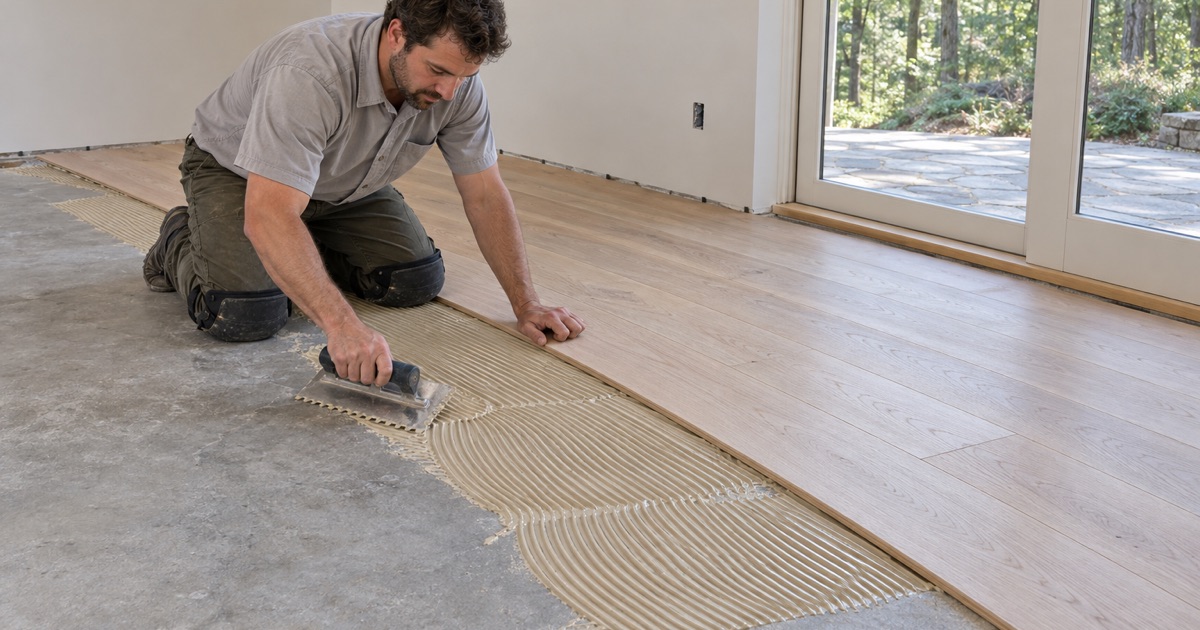
Putting solid hardwood over a slab means building a wood subfloor first, which adds height and cost and changes door clearances. Engineered boards can be glued straight to a flat, dry slab or floated over underlayment. That keeps the floor height close to what was there before and avoids trimming every door.
Upper Floors and Whole-House Projects
Engineered wood is not only for slabs. On upper floors and main levels over a crawlspace, it can be nailed down like solid hardwood and chosen for its stability, prefinished color or wide plank look. Some owners use it throughout so every level matches without any transition between materials.
A whole-house engineered floor also means one supplier, one finish and one set of care instructions. When a board is damaged years later, a replacement from the same product line is far easier to find than a match for a mix of materials.
Wear Layers, Cores and What You Are Paying For
The Engineered Wear Layer
The wear layer is the real hardwood on top, and its thickness decides how many times the floor can be sanded. A thick wear layer can be refinished like solid wood, while a thin one can only take a screen and recoat. We show you the wear layer on the sample so you know what you are buying.
For a main living area you plan to keep, we lean toward a wear layer that can take at least one full sanding. For a lower level, a guest suite or a rental, a thinner layer can be a reasonable way to spend less.
Plywood and Multi-Ply Cores
The core is made of cross-layered wood plies that resist the swelling and shrinking that make solid boards cup and gap. Better cores use more plies and denser wood, which keeps the board flatter over time. Cores built from hardwood plywood fall under the formaldehyde emission standards of TSCA Title VI, and compliant products carry a label saying so.
Cheaper boards sometimes use a fiberboard or thin softwood core that dents more easily and holds fasteners poorly. We ask for the product data sheet on anything we install and pass it on to you, so you know exactly what is under the wood you walk on.
Species, Width and Finish
Engineered boards come in white oak, red oak, hickory, maple and exotic species such as Brazilian cherry, in widths from narrow strip to wide plank. Hickory and Brazilian cherry rank high on the Janka hardness scale, which helps with dogs and heavy traffic. Most are prefinished at the factory, though some unfinished engineered boards can be sanded and stained on site.
Factory finishes are usually harder than anything applied in a house, which helps in kitchens and entryways. The tradeoff is that the color is fixed, so we bring full boards to the house and lay them out in your own light before you order.
Choosing the Installation Method
Glue-Down Engineered Floors
Gluing engineered boards to a slab gives a solid feel underfoot and a sound close to nailed hardwood. The adhesive, the trowel and the slab preparation all matter, because poor coverage leaves hollow spots that click and eventually loosen. We check that the slab is flat before we spread any adhesive.
High spots are ground down and low spots filled with a patching compound, because an engineered board bridging a dip will flex and lose its bond. Some adhesives also double as a moisture barrier, which can save a separate step on a slab that reads slightly damp.
Nail-Down and Staple-Down Installations
Over a plywood subfloor, engineered boards can be fastened with flooring cleats or staples like solid hardwood. The fastener size and spacing follow the manufacturer’s instructions and the NWFA Installation Guidelines. A proper nail-down floor feels firm and quiet for decades.
Floating Floor Installations
A floating floor locks board to board and rests on an underlayment instead of being fastened down. It goes in quickly and can sit over some existing floors, but it needs an expansion gap at every wall and can sound hollower than a glued floor. We use it where its advantages outweigh that tradeoff.
A quality underlayment reduces that hollow sound and adds a layer of moisture protection over a slab. Floating floors also make sense in a condominium where the association limits how flooring can be fastened, as long as the underlayment meets the building’s sound rule.
Moisture, Humidity and Georgia Conditions
Acclimation and Readings
Alpharetta sits in IECC climate zone 3, with long, humid summers and drier air when the heat runs in winter. Engineered wood moves less than solid hardwood through those swings, but it still needs to acclimate to the house and still needs a dry subfloor. We record moisture readings for both before installation.
Vapor Retarders and Underlayments
Over a slab or a crawlspace, a vapor retarder slows moisture from reaching the boards. In townhomes and condominiums, an underlayment may also be required to reduce sound transmission to the neighbors. We choose products that meet both the moisture conditions and any association rule that applies.
When an association requires approval before hard flooring goes in, we confirm it in writing before ordering materials. Your declaration, not state law, sets that rule, and it is far easier to meet it up front than to relay a floor after a violation letter.
Keeping the Floor Stable Year Round
Running the air conditioning in summer and, in very dry winters, a humidifier keeps engineered floors stable. A dehumidifier helps on a terrace level that stays damp. We leave you with simple guidance for the rooms we floored.
- 20+ Years on Wood Floors
- Moisture Readings Before Sanding
- Stairs Quoted Tread by Tread