Alpharetta Wood Flooring handles hardwood floor water damage in Alpharetta, GA and has spent 20+ years drying, repairing and refinishing floors that met the wrong side of a leak, serving surrounding cities including Roswell, Milton, Peachtree Corners, Norcross and Sandy Springs. We trace where the water came from, measure how far it went, and decide what can be saved before a single board comes out.
Water damage on a wood floor is rarely as small as the stain that first shows. A dishwasher drain that dripped for a month, a refrigerator line that split behind the cabinet or a storm that came under a door can soak the subfloor well beyond the boards that look damaged. Replacing the visible boards without drying and measuring the rest only guarantees the problem comes back.
We also document every step for your insurance adjuster. Readings, photographs and a room-by-room record of what was wet, what dried and what had to be replaced give the adjuster a clear picture, and they give you a floor repaired to match rather than patched to pass.
Finding Where the Water Came From
Supply Lines, Dishwashers and Refrigerator Lines
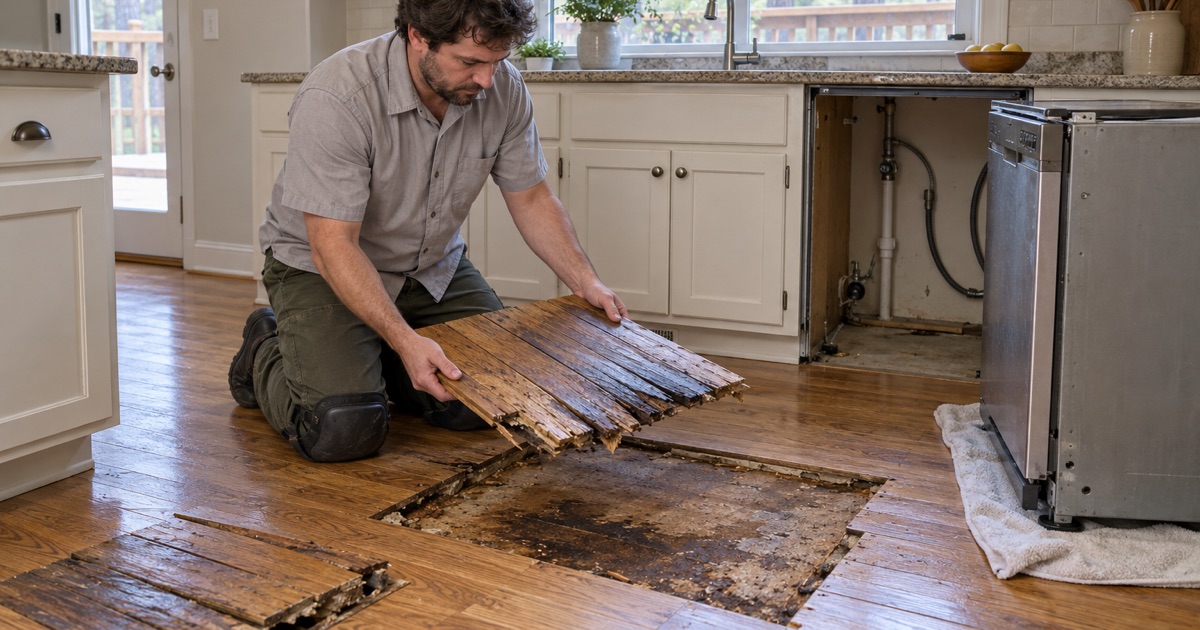
The most common sources inside a house are a dishwasher hose, an ice-maker line, a sink supply valve or a toilet supply line. Slow leaks from these can run for weeks under cabinets before the floor shows anything. We check each likely source around the damaged area and note what we find.
When the source is not obvious, the pattern of the damage helps. Water that spread from under a cabinet reads differently on a moisture meter than water that came through an exterior wall, and the readings usually lead back to the leak.
Storms, Doors and Exterior Walls
Wind-driven rain can come under a door or through a failed threshold, and water can wick into the floor along an exterior wall after a heavy storm. That damage tends to show up near doors, windows and the edges of rooms. Replacing the boards without fixing the door or the flashing only sets up the next repair.
Storm damage also tends to arrive in more than one room at once, which matters for the claim. We note the date of the storm, the rooms affected and the entry point, so the adjuster can connect the damage to a single event rather than treating it as long-term seepage.
Water From Below
Some damage comes from underneath: a wet crawlspace, a plumbing leak in the basement ceiling, or moisture rising through a slab. The boards cup even though no water ever sat on top of them. We look under the house wherever we can, because the fix for water from below is very different from the fix for a spill.
Humid summers make this worse. Warm, damp air in an unconditioned crawlspace condenses on the cool underside of the floor, and a floor that was fine in spring can cup by August.
Drying and Measuring Before Any Repair
Moisture Readings Across the Floor
We take moisture meter readings in the damaged area, at its edges and in unaffected rooms, so we know what normal looks like in your house. Those numbers tell us how far the water spread and when the floor has truly dried. We record every reading so the adjuster and you can see the same data we do.
Readings continue over the drying period. A floor that has dried on top but still reads high below is not ready for sanding, however flat it looks.
Cupping, Crowning and Buckling
Wet boards swell and cup, with edges higher than centers. If the floor is sanded flat while still wet, the edges shrink as it dries and the floor ends up crowned. In severe cases the swelling is strong enough to lift boards off the subfloor, which is called buckling. Knowing which stage the floor is at decides what we do next.
A cupped floor that is caught early often needs nothing more than drying and a refinish. A buckled floor usually needs boards removed to relieve the pressure, and sometimes the subfloor needs replacing where it stayed wet too long.
Fans, Dehumidifiers and Patience
Many cupped floors flatten substantially once the water source is fixed and the room is dried with fans, dehumidifiers and air conditioning. That process takes time, and it saves boards that a hurried repair would tear out. We tell you what to run and check back with readings until the floor is ready.
Deciding What Can Be Saved
Boards That Recover
Solid hardwood that flattens back after drying, with no black staining or delamination, can usually be sanded and refinished. Minor water stains near the surface often sand out. Keeping the original boards means a better match and a lower cost.
Engineered floors are less forgiving. Once water gets into the core, the layers can swell or separate, and a board that looks flat on top may still be delaminating underneath. We check engineered boards closely before calling them saved.
Boards That Need Replacing
Boards that stay cupped after drying, show black water stains through the wood, split, or come apart in layers on an engineered floor need to be replaced. Laminate and luxury vinyl plank rarely recover once their core has swollen. We cut out damaged boards and weave in matching stock so the repair follows the floor’s pattern.
When the subfloor has softened or started to rot, that section is replaced too. New boards on a weak subfloor will squeak and fail early.
Matching New Wood to Old
New boards have to match species, width, grade and finish, and on a site-finished floor they are sanded and finished with the surrounding area. Blending a small patch into an older finish is difficult, so a room or an area to a natural break is often refinished together. We explain the options and the likely result before we start.
Where the floor runs continuously through several rooms, stopping the refinish at a doorway may be the only clean place to end. We mark those natural breaks on a sketch of the floor plan, which also helps the adjuster see why the repair area is shaped the way it is.
Documentation for Insurance Claims
A Room-by-Room Record
For each affected room, we record the moisture readings, the extent of damage, photographs before anything is removed, and what we recommend replacing or refinishing. That record is organized so an adjuster can follow it without a phone call. It also protects you if questions come up later in the claim.
Explaining the Scope
Adjusters often start with the damaged boards alone. When a proper repair needs more, such as refinishing a whole room to avoid a visible patch, we explain why in writing, with the species, finish and layout details that make a partial repair show. You get a clear estimate that separates drying support, board replacement and refinishing.
Working Alongside Mitigation Crews
If a water mitigation company is already drying the house, we coordinate with them rather than duplicating their work. Their readings and ours together give the most complete picture, and the handoff from drying to repair happens without gaps.
- 20+ Years on Wood Floors
- Moisture Readings Before Sanding
- Stairs Quoted Tread by Tread